
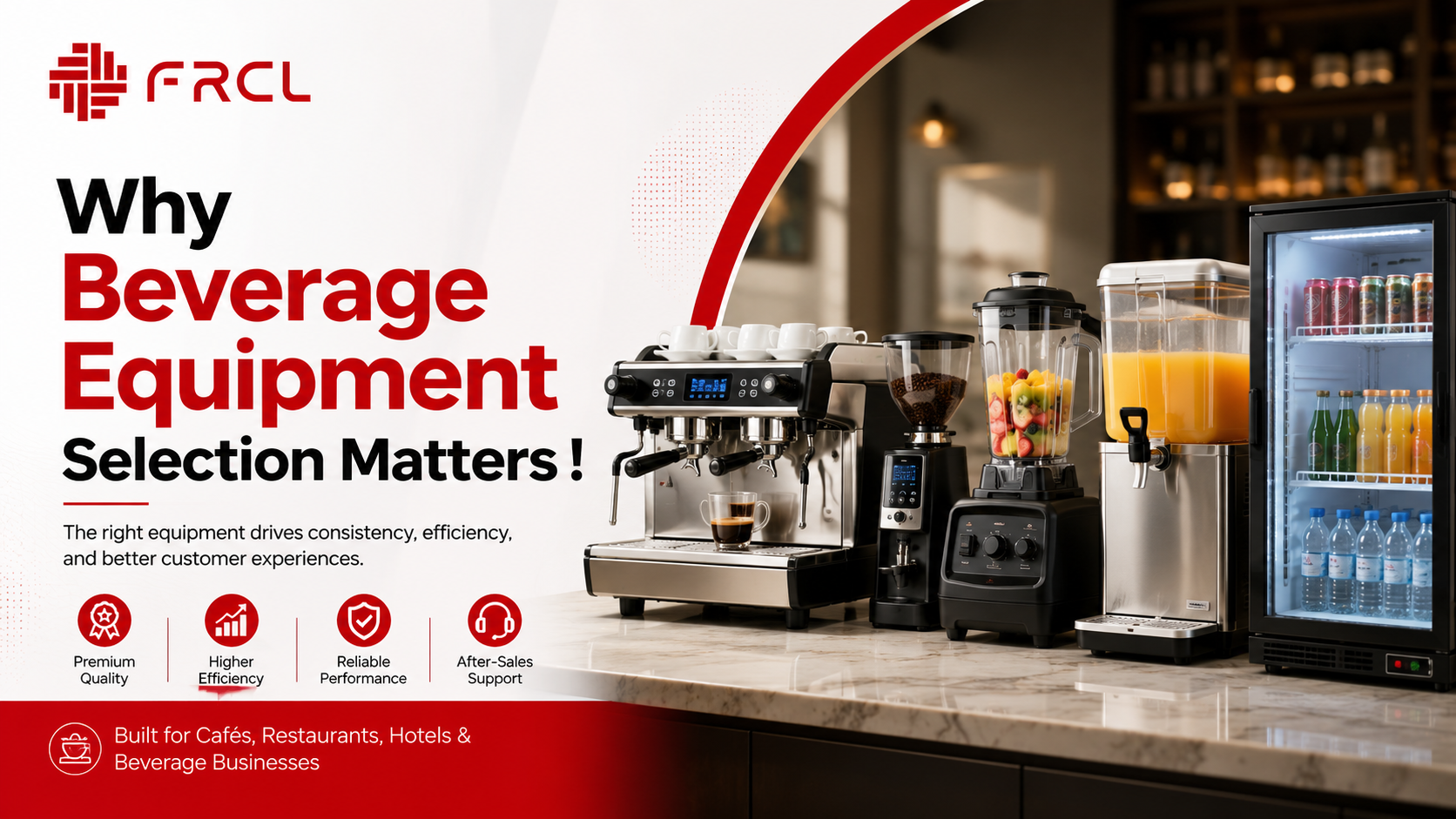
A beverage business depends heavily on speed and consistency. Customers expect the same taste, temperature, texture and presentation every time they place an order.
The wrong equipment may create:
A professional equipment plan connects the menu with the required production capacity.
Commercial beverage equipment may be required by:
A small takeaway coffee counter may need only a compact coffee machine, grinder, refrigerator and water filter. A high-volume café may require a multi-group espresso machine, several grinders, large ice maker, commercial blender and glass washer.
The menu determines the equipment list.
Create categories such as:
Then estimate the maximum number of drinks required per hour.
This calculation helps determine machine capacity, number of workstations and ice requirements.
Commercial espresso machines are designed for repeated drink preparation. Available options may include compact, single-group, two-group and larger configurations.
Before selecting a machine, consider:
A machine that is too small may struggle during peak periods. A machine that is unnecessarily large may consume more space and investment.
Grinding quality strongly affects coffee preparation. A café may need separate grinders for different beans or recipes.
Review:
The grinder should be matched with the espresso machine and expected order volume.
Depending on the concept, the business may require batch brewers, pour-over systems, hot-water dispensers or coffee urns.
Hotels, conference venues and catering operations may prefer equipment that can prepare and hold larger quantities.
Commercial blenders are used for smoothies, frappes, milkshakes, sauces and crushed-ice drinks.
Important specifications include:
Household blenders are generally not designed for the order frequency of a busy beverage shop. A commercial model should be selected according to actual workload.
Ice is one of the most important ingredients in many beverage operations.
An ice shortage can stop the sale of cold drinks even when every other ingredient is available.
Before purchasing an ice maker, calculate:
Ice makers may produce cubes in different shapes and sizes. The correct type depends on drink presentation, melting rate and business concept.
The rated production capacity should also be reviewed in relation to local operating conditions. High room temperature or warm incoming water can affect actual output.
Beverage operations require cold storage for milk, cream, fruits, syrup, concentrates, bottled drinks and prepared ingredients.
Suitable products may include:
Frequently used ingredients should be placed close to the beverage station. This reduces staff movement and improves service speed.
A juice or beverage business may require:
Equipment selection depends on whether drinks are prepared fresh, pre-mixed, bottled or dispensed in batches.
Bubble-tea operations often require a combination of cooking, cooling, sealing and beverage-preparation equipment.
A typical setup may include:
The workstation should allow staff to move quickly from order receipt to drink assembly and sealing.
Hotels, restaurants and cafés may use hundreds of glasses during busy service periods.
A commercial glass washer can help improve speed and maintain a more organized bar or beverage station.
Before selecting one, review:
The washing station should have separate areas for used and clean glasses.
Water affects coffee flavour, ice quality, machine performance and cleaning results.
Depending on local water conditions, beverage businesses may require:
Water treatment should be matched with machine-manufacturer requirements. An unsuitable filtration system can affect taste or equipment operation.
An efficient beverage counter should support a clear production sequence.
A common flow is:
Order → Cup preparation → Ingredients → Mixing or brewing → Ice → Finishing → Sealing → Handover
Frequently used items should remain within easy reach.
The layout should consider:
Overcrowding the counter with machines can slow down employees and make cleaning difficult.
A suitable supplier should help the customer evaluate:
Avoid purchasing a machine only because it appears popular online. A product suitable for another country or business model may not match the available utilities or local working conditions.
Commercial beverage equipment prices vary according to brand, capacity, automation, origin, construction and included accessories.
When requesting a quotation, ask for:
Comparing complete specifications is more useful than comparing only the final price.
FRCL supplies commercial beverage and kitchen equipment for cafés, restaurants, hotels, bakeries and beverage-focused businesses in Bangladesh.
Customers can discuss:
FRCL can also support projects that require beverage equipment as part of a complete restaurant or hotel kitchen setup.
A basic coffee shop may require an espresso machine, grinder, water-filtration system, refrigerator, blender, ice maker, sink and suitable preparation counter. The final list depends on the menu.
Multiply the approximate amount of ice used per drink by the expected number of daily drinks. Add ice used for food display, cleaning or other operations, then include additional capacity for peak demand.
Many commercial blenders are designed for ice-based drinks, but capability differs by model. Check motor power, blade design and manufacturer recommendations.
Equipment and project requirements can be discussed for businesses across Bangladesh. Delivery and installation arrangements depend on the product and location.
Suitable filtration can help control sediment, taste and scale. The correct system depends on local water quality and the machine manufacturer’s requirements.
Customers can share the menu, counter dimensions, expected order volume and utility details for equipment and layout recommendations.
Whether you are opening a café, juice bar, bubble-tea shop, hotel bar or restaurant beverage section, the right equipment can help improve speed, consistency and customer experience.
For commercial beverage equipment consultation and quotations in Bangladesh, contact FRCL.
Call: 01810-197458
Email: info@fatinrelieve.com
Service Coverage: Dhaka and projects across Bangladesh